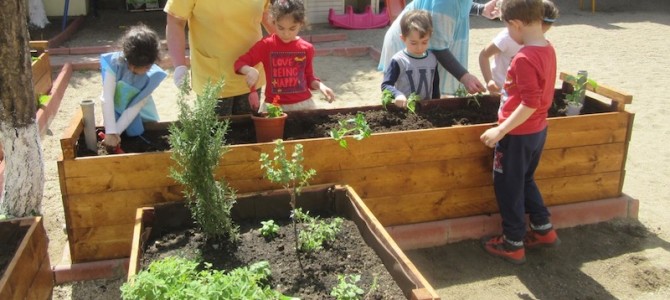
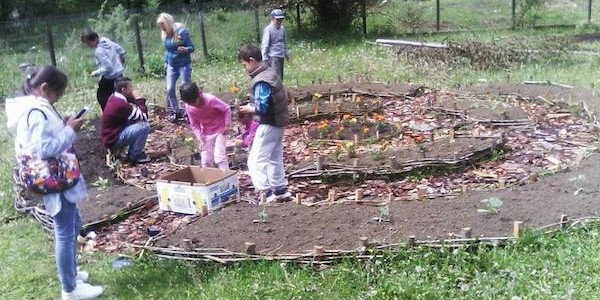
Inspired by the „Children in Permaculture” project, the teachers and children of the Rasarit kindergarten planted a raised garden that became a fresh source of joy and inspiration for everyone! The children are delighted every day to see their plants grow, to rub their hands with the aromatic leaves of mint and basil and breathe in the scent, to watch the cucumber grow and lengthen every day!
The children were involved in planting seeds and caring for them until they grew into plants for transplanting. They then transplanted the plants and watched them grow. Soon they were eating peas, swiss chard and cucumbers in their salad at lunchtime. The experience was empowering, and a source of pride and excitement for everyone involved.
Un videoclip facut impreuna cu copiii despre schimbul de experienta in cadrul proiectul „Copii in Permacultura” care a avut loc in luna mai 2017:
As the group of 19 Scottish school children from the „Children in Permaculture” (CiP) project, all wearing matching green baseball hats, waited in the Otopeni airport in Bucharest for their delayed flight home, they decided to use the opportunity to interview each other about their experience over the previous five days in Romania.
„It was the chance of a lifetime,” enthused one of the boys, „I hope to come back, and meet all my friends again.”
„I really loved the Romania trip” another girl said, then proceeding to list her favorite memories of the trip.
„I got to learn a lot about permaculture and the ethics and principles. It was great fun!”
„I hope to come back with my family, because I think they would really like it too.”
What made the experience so memorable?
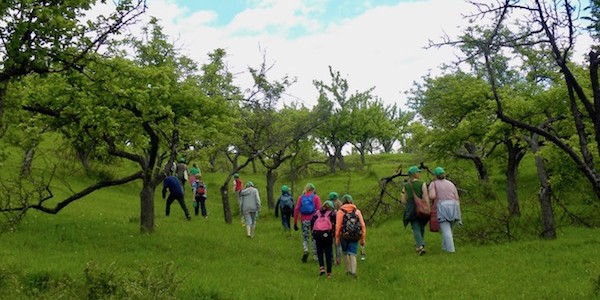
Every day was packed with learning through novel adventures, exploration and hands-on outdoor activities in nature. It was not your typical touristic trip, visiting monuments and museums. Rather, the children had an experience from the „inside”, playing alongside Romanian children their own age at the „Fountain of Hope” afterschool center in Panatau, a small rural village in the mountains of Buzau county.
În perioada 15 – 19 mai, Asociația Educației Neoumaniste a organizat în cadrul proiectului european „Copii în permacultură” un schimb de experiență româno-scoțian despre permacultură. Astfel, 19 elevi ai școlii Gatehouse din Scoția împreună cu 30 de copii din cadrul Centrului de zi „Izvorul Speranței” (satul Pănătău, județul Buzău) au învățat noțiuni despre permacultură, grădinărit sau ecologie.
Vă invităm să aflați mai multe despre aventura micilor participanți din articolul scris de Ana Racheleanu și publicat în Green Report.
AEN s-a alaturat primei intalniri, care s-a dorit a fi un preambul al unui nou proiect, destinat sa prezinte tinerei generatii perspectiva holistica, extrem de atragatoare, a permaculturii, dar si aspectele practice ale acesteia.
„Tinerii in Permacultura (YIP)” este o initiativa inedita, care isi propune sa ajute tinerii sa isi creeze vieti pline de impliniri, de voie buna si de spiritualitate, totul urmand invataturile din permacultura. Didi a reprezentat AEN la prima intalnire, care a avut loc in Spania, acolo unde s-au adunat laolalta organizatii din mai multe tari, din toata lumea.
Incurajati de succesul proiectului „Copiii in Permacultura (CIP)”, tinerii implicati, dar si liderii acestei comunitati a permaculturii (tineri sau nu, dar cu siguranta cu suflete tinere) s-au strans si au alcatuit o echipa puternica si entuziasta ( din opt tari ), care de-abia asteapta sa inceapa acest nou demers.
Avem o pagina web care prezinta resursele, mijloacele, conexiunile online si proiectele noastre. Am inceput sa planificam evenimente, activitati si workshop-uri si vom trimite toate aceste informatii tuturor celor interesati sa sustina acest proiect deosebit. Pentru mai multe informatii, va rugam sa accesati: www.youthinpermaculture.org
Sociocrația este un proces sistematic pentru facilitarea dinamicii de grup, care încurajează participarea deplină, responsabilitatea comună și o mai mare eficiență în procesul de luare a deciziilor.
Metoda se bazează pe ideea că fiecare dintre noi are o perspectivă valoroasă și că cele mai bune decizii se iau atunci când sunt implicați toți stakeholderii în proces, aplicând astfel înțelepciunea colectivă a întregului grup.
Sociocrația se utilizează în mod eficient pentru orice, de la managementul proiectelor internaționale, la organizarea și dezvoltarea eco-satelor sau a companiilor de inginerie electrică.
Puteți afla mai multe informații despre Sociocrație aici!
In data de 14 mai, 19 elevi cu varste intre 11 si 12 ai scolii “Gatehouse” din Scotia, vor ajunge in Romania, pentru a se intalni cu copiii din Centrul de zi „Izvorul Sperantei”. Intre 15 si 18 mai, micii romani din Panatau le vor prezenta elevilor scotieni, viata de zi cu zi dintr-un mic satuc autohton si ii vor familiariza pe acestia cu tehnici traditionale de agricultura, demult uitate in tari puternic industrializate. Acest schimb de experienta este condus de Asociatia “Educatie Neoumanista”, una dintre cele 5 organizatii partenere ale proiectului “Copiii in Permacultura”, un proiect Erasmus plus, finantat de Uniunea Europeana.
Copiii scotieni vor avea sansa sa admire frumusetile naturale ale micutelor sate romanesti. Acest schimb de experienta isi propune sa-i determine atat pe elevii romani, cat si pe invitatii lor scotieni sa aprecieze viata simpla si linista din zonele rurale, in contextul in care, la nivel mondial, se observa o tendinta in crestere de parasire a mediilor rurale (mai ales de catre tineri), in favoarea marilor aglomerari urbane.
We are very happy to have been accepted as a new member of the International Step by Step Association!
ISSA is a membership association, which serves as learning community and a champion for quality and equity for all children and their families.
Already, AEN has been participating over the last 5 years in international conferences organized by ISSA, which have always served as valuable learning experiences and opportunities to network with like-minded practitioners committed to progressive change in early childhood education.
In October, the International Step by Step Association (ISSA) organized a conference for early childhood professionals with the theme „Early Childhood in Times of Rapid Change” that took place this October in Vilnius, Lithuania. The conference explored four main strands – Meaningful Learning for Children, Meaningful Preparation for the Workforce, Meaningful Support for Families, Meaningful Use of Technology. The conference sought to address the experience of rapid changes facing societies around the world, bringing together experts, researchers, practioners, policy makers and NGOs to discuss these themes in a variety of interactive sessions. There was a particular emphasis on the refugee crisis and several presentations shared strategies on addressing the needs of children and families affected by displacement and the traumas of war, natural disasters or economic crisis.
I was invited to present two Neohumanist Education projects: The „Pathways to Education” project for Syrian refugee children run by AMURT Lebanon, and the „We all have a Story” project promoting inclusivity in early childhood education that took place in Romania. I was able to participate, thanks to support from the Zonnelicht school. It was an excellent opportunity for Neohumanist Education approaches to gain visibility amongst leaders in the field, as well as to learn about innovative new developments in ECE and create new networking connections with like-minded organizations and people. A Dutch organization was particularly interested in exploring collaborations in working with refugees. Connections were also made for developing further projects in the integration of severely marginalized Roma communities.
by Didi Devapriya Deshaies
In October, the International Step by Step Association (ISSA) organized a conference for early childhood professionals with the theme „Early Childhood in Times of Rapid Change” that took place this October in Vilnius, Lithuania. The conference explored four main strands – Meaningful Learning for Children, Meaningful Preparation for the Workforce, Meaningful Support for Families, Meaningful Use of Technology. The conference sought to address the experience of rapid changes facing societies around the world, bringing together experts, researchers, practioners, policy makers and NGOs to discuss these themes in a variety of interactive sessions. There was a particular emphasis on the refugee crisis and several presentations shared strategies on addressing the needs of children and families affected by displacement and the traumas of war, natural disasters or economic crisis.
I was invited to present two Neohumanist Education projects: The „Pathways to Education” project for Syrian refugee children run by AMURT Lebanon, and the „We all have a Story” project promoting inclusivity in early childhood education that took place in Romania. I was able to participate, thanks to support from the Zonnelicht school. It was an excellent opportunity for Neohumanist Education approaches to gain visibility amongst leaders in the field, as well as to learn about innovative new developments in ECE and create new networking connections with like-minded organizations and people. A Dutch organization was particularly interested in exploring collaborations in working with refugees. Connections were also made for developing further projects in the integration of severely marginalized Roma communities.
A new term that was repeatedly used in the conference was „Generation Touch” referring to the impact of touch screen technology on children who are growing up in a world where they expect every object to perform like a screen, responding instantaneously to touch. This phenomenon was explored in several of the presentations I attended. Generally, there was a consensus that technology should scaffold and support, rather than replace other types of educational interventions, and that its use should be very limited in the earliest years of a child’s life, as it can affect neurological development. In her keynote speech, Professor Liz Goodman who teaches „Inclusive Design” in Dublin, also described innovations in the use of technology to support the inclusion of special needs children, such as an innovation that allows paralyzed people to move a mouse with their eye movements. She talked about how technology can assist in personalization of services as „one size fits one”.
I particularly enjoyed a lively peer debate on the appropriate use of technology in early childhood education. I was expecting to listen to a panel of experts debating the pros and cons of technology, so I was quite taken aback when I walked in through the door and the moderator asked me whether I was for or against the use of technology in Early Childhood education – I answered „It depends…” but we had to all choose a stand and then go through a formal debate process. I ended up on the anti-tech side and argued that the most important piece of technology we must teach children to master is our own body, heart and mind. However, in reality – I recognized that technology is very difficult to avoid, and it is simply a fact that we must learn to deal with in appropriate ways. Another conclusion that was also mentioned several times in the course of the conference, is that the increase in screen time, needs to be balanced by increased conscientious attention on developing empathy and relationships.
Another keynote presentation, by Nicholas Burnett, introduced the Lancet Series, which Advancing Early Childhood Development: from Science to Scale. The journal is a prestigious medical and scientific journal, which has gathered evidence to quantify the impact of early childhood education. The study shows that „children who are not nurtured properly in the early years may forfeit a quarter of their earning capacity as adults. The Series provides a roadmap to successful interventions in early childhood, along with evidence that such interventions contribute directly to ending extreme poverty, boosting shared prosperity, promoting healthy lives and learning, reducing inequalities, and maintaining peaceful societies.” The findings from the Lancet series emphasize „‘nurturing care’, especially for children below three years of age: multi-sectoral interventions starting with health – which can make a profound impact on families and young children through health and nutrition.” Dr. Burnett made a comparison with climate change – that a change in our individual behavior will not to seem to have any impact in the short term, but unless we take actions now, we will all be in much worse problems in the future.
Indeed, the Lancet series evidence has already proven useful in convincing policy makers to include investments in Early Childhood Education as part of the UN Millenium Development Goals and on more local levels. The conference concluded with the screening of a new documentary video „The Beginning of Life” which similarly can be very useful in supporting efforts to convince parents, policy makers etc about the importance of investing in early childhood education.
Children in Permaculture is a 3-year project funded through Erasmus+ Key Action 2: School Education. The partnership is across 5 countries: UK, Romania, Czech Republic, Slovenia, and Italy.
CiP is an innovative project of international cooperation bringing together key educators (from different schools, nurseries, practices and countries) in order to cross-fertilise, share and synthesise ideas, which will strengthen the capacities of all involved.
This international exchange will develop, test, adapt and implement practices in permaculture education with children. It will:
develop a permaculture curriculum suitable for children
create well designed materials for educators
collect and create an open education resource
foster a cohesive society through learning with people from other countries and cooperation between formal and informal education settings
share best practice and new perspectives on designing kindergartens and schools, and promote better outdoor learning experiences for children.